ZW-2026STEREO
Open toRelocateEnglish speaking
Booking enquiries welcome
I find the problem, build the fix, and make sure people use it.
Seventeen years in content, now building with AI. Open to forward deployed, solutions engineering, AI implementation and creative technologist roles. International, English speaking, and open to relocation.
Seventeen years of writing, five brands at work, and my own products on Side A. Below is what I’d do in my first 90 days, then the case studies with the numbers.
My first 90 days
As a forward deployed AI hire, on any team with a messy problem.
- Days 1 to 30Listen and map
Sit with the team, watch how the work really gets done, and map the workflows. I’d pick the one where AI saves the most time with the least risk, and agree with the team what “better” will look like in numbers.
- Days 31 to 60Ship one thing, measured
Build one Claude Skill or agent for that workflow, with guardrails: brand rules, claim checks, and a person approving anything that goes out. Then test it against how the team did it before.
- Days 61 to 90Roll it out and teach it
Hand it over properly, with short how-tos and sessions with each person who’ll use it. I’d fix what trips people up in the first weeks, because that’s usually where these tools get dropped.
- Day 90Report the numbers
Share adoption numbers with the team: who uses it, how often, time saved and anything it caught. Then use those to choose the next workflow.
Case studies
Six of them in more detail, with the numbers.
Vera. Teaching a machine to listen like a music writerCase 01
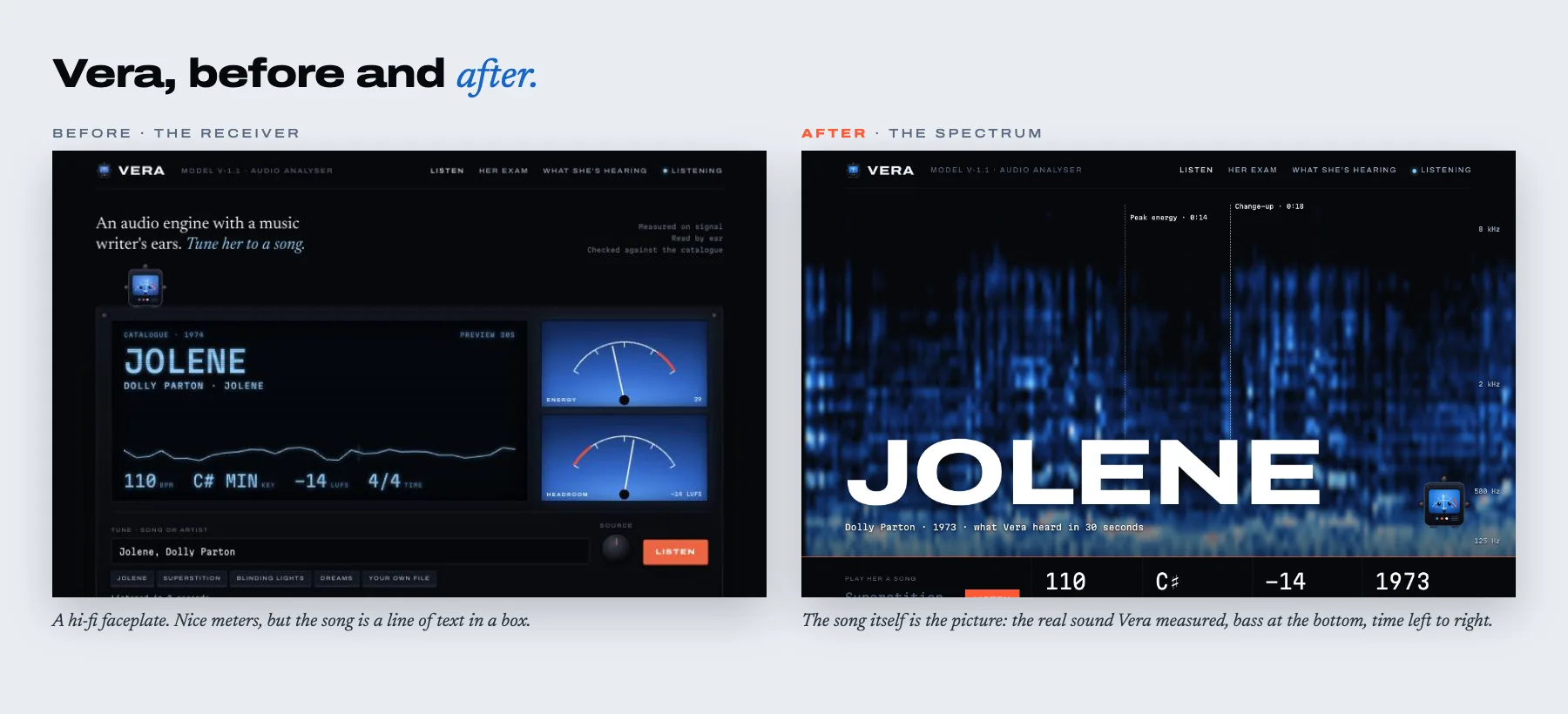
 This is Vera now: a little meter with a face, and her site, before and after this week’s rebuild. It used to be a hi-fi faceplate. Now it draws the real sound of every song she hears, so the song itself is the picture.
Why. When I was writing reviews, I wanted to go deeper on the music that mattered to me: something that could pinpoint what I was hearing, so I could work out how and why a track hits the way it does. The open-source audio models couldn’t, not out of the box. Mine called 27% of every song it heard “latin” and 21% “blues”. It had a few favourite words and used them on everything.
What I did. Built a baseline from 234 chart songs so she could tell “unusually bright” from “everything sounds bright to me”. Trained a genre model on about 900 labelled previews. Rewrote how she finds the beat. Set her a blind exam of 1,137 songs she’d never heard, plus torture tests: chord loops, drum loops, pitch shifts, noise. Then wrote her a voice guide, so she talks like someone who loves music.
What changed. Genre in the right family went from 63% to 68% on songs her model never trained on, and her favourite label went from 27% of every song to no label above 7%. On my fixed set of 30 songs, tempo went from 71% to 86% and key from 60% to 70%. In the big exam she gets tempo right 92% of the time counting half or double time, and keys 24 out of 24 on chord loops. Turned 12 dB down or squashed to a 64 kbps MP3, she held her answer 38 times out of 40. Every before and after is on her site, misses included. She got good enough that I use her for my own writing, and I figured other people might like her too, so she’s public and runs on her own always-on server.
The bit I nearly missed. In November I tested everysong’s new tools on the live site and the tempos looked off. Smells Like Teen Spirit came back far too slow. It turned out the live site had never loaded her: it was quietly running a fallback engine the whole time. I fixed the deploy so she ships with it, checked the server logs, and ran the same song again. Right tempo.
Skills: audio machine learning, evaluation design, Python, API and MCP design, production debugging, product voice.
Make a game (no AI). A game maker for kids, with no AI in itCase 02


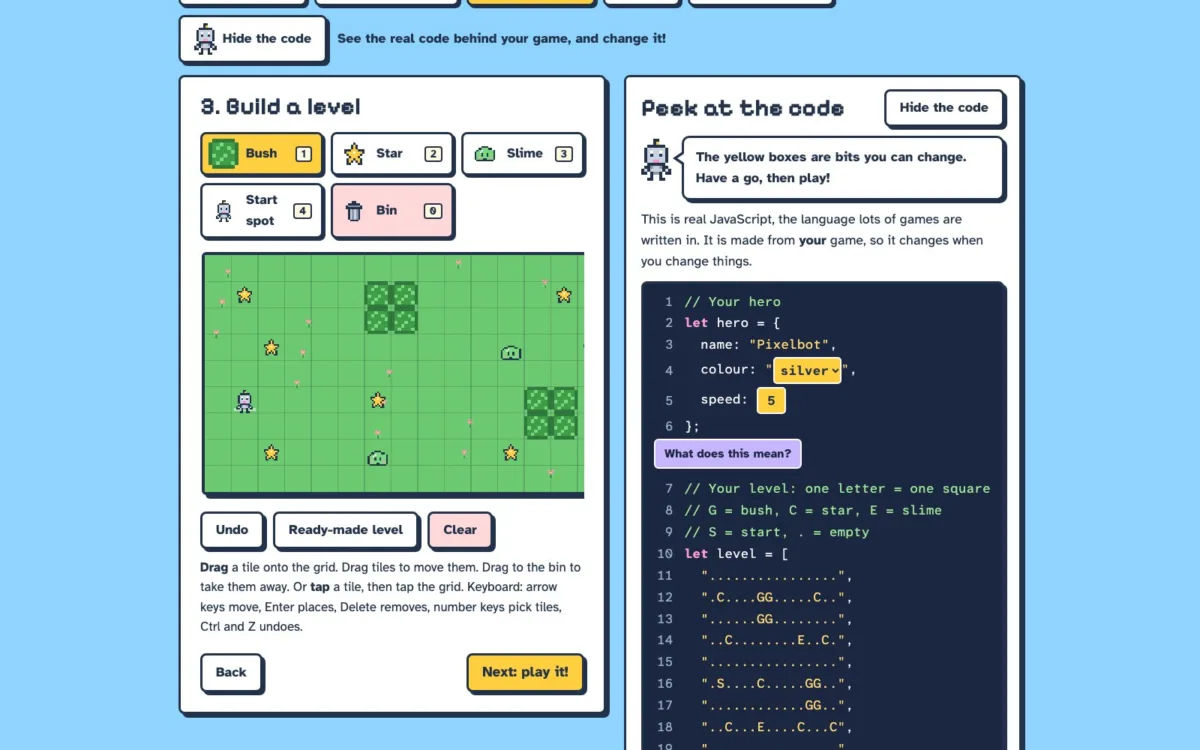
The problem. The brief was clear: kids shouldn’t have to use AI to make something of their own. The rest of Pixeldex is about making games with Claude, which is great for grown-ups. Kids needed their own corner, where every idea and every click is theirs.
What I built. Make a game (no AI), for 7 to 13 year olds. Pick a game, a hero, an enemy and a world, then drag tiles onto a grid to build a level. Play it with the keys or the buttons on screen, then save it, share it as a link or download it as one file that plays anywhere, even offline. Pixelbot walks you through it, and every word he says was written ahead of time. Then there’s “Peek at the code”. It shows the real JavaScript made from your own game, explains each bit in plain words, and lets you change the speed, the jump or the points right there and watch your game change.
Built for kids, properly. A font picked for easy reading, big text, strong contrast and big buttons for small fingers. Nothing talks to an AI. Nothing you make leaves your computer unless you share it, and a share link carries the whole game inside it, so no server keeps a copy. No ads, no tracking, no sign up, and no scripts from anywhere else. I wrote it all up for parents on the AI-free zone page.
Making it feel like a game. The written guides were a lot of reading for a nine year old, so now there are stars. In Make a game, Pixelbot sets 11 little missions, like win your game or change a number in the code, and each one lights up a star. The kids’ walkthrough for making a game with Claude got the same idea: Pixelbot takes you through it one small step at a time, with a copy button right there, a star for every step you finish, and a calm “something looks wrong” fix if it goes sideways. It remembers where you got to, on your own computer and nowhere else.
How I tested it. I played every step with a mouse, with taps on a tablet, and with the keyboard alone. I checked what the page loads: its own files and a font, nothing else. The boxes you can type into in the code only take sensible numbers, so a typo can’t break anyone’s game.
What’s next. Putting it in front of kids and their grown-ups, watching where they get stuck, and fixing that first. Then more game types, and more of the code they can change.
Skills: listening to the brief, design for children, game design, accessibility, privacy by design, JavaScript and canvas, teaching code.
everysong. Rebuilding a live product properlyCase 03
The problem. People were using everysong every day, with uploads rising every month from August to October. But when I went back through it, three things weren’t good enough: too few matches sat on the right beat, the catalogue needed a cleaner source, and the free daily limit had never actually worked.
What I did. Put it on a holding page while I rebuilt it, and made everysong fully free. Rebuilt the catalogue from the Jamendo API, licence-filtered and measured by Vera. Tested everything before relaunch, and started a dated log with a weekly check that it all still holds.
Then I made it properly useful for editors. Every readout now maps the beat for the whole song: the BPM, where every bar starts, frames per beat at 24, 25 and 30fps, and a CSV you can drop straight into your timeline. There’s a swap check: upload the track you’re thinking of using and it tells you straight whether your cuts will still land. And Artists like… shows who else an artist’s listeners play, from open MusicBrainz and ListenBrainz data. All free, no account. It’s the part I’m proudest of, because it’s the bit I’d actually open in the middle of an edit.
What changed. Matches are now ranked by sound first, then by tempo and key, so a swap drops onto the edit without re-timing. The catalogue went from 5,079 tracks at relaunch to 12,751 two days later, every one licence-checked and measured by Vera. The daily upload limit that had never worked now does. The before and after are on everysong. And I wrote guides for people searching for these tools.
Skills: product judgement, licensing and compliance, data pipelines, API design, tools for editors, release testing.
Hi-Fi Kitchen. A 15-year blog that runs itselfCase 04
The problem. I started it in 2011 as family life, recipes and travel. A thousand posts later it needed to become one focused thing without losing its history, and stop eating my evenings.
What I did. Turned it into honest reviews of the hi-fi and kitchen kit I actually own. Automated the publishing pipeline: links, cover art and scheduling. Set it up for AI search as well as Google, and connected it to Claude so I can work on it there.
What changed. Over 1,000 posts since 2011, all still live and now one focused site. New posts go out on schedule without me touching them.
Skills: SEO and AI search, editorial strategy, WordPress, automation, writing.
DraftFolk. Free writing software, because writing shouldn’t cost moneyCase 05
Why. I finished a novel through NaNoWriMo years ago, mostly because tracking my words made me feel like I was going towards something. I didn’t love the community, and then came the controversy. I’d paid for the tools that kept me going, and I didn’t think anyone should have to.
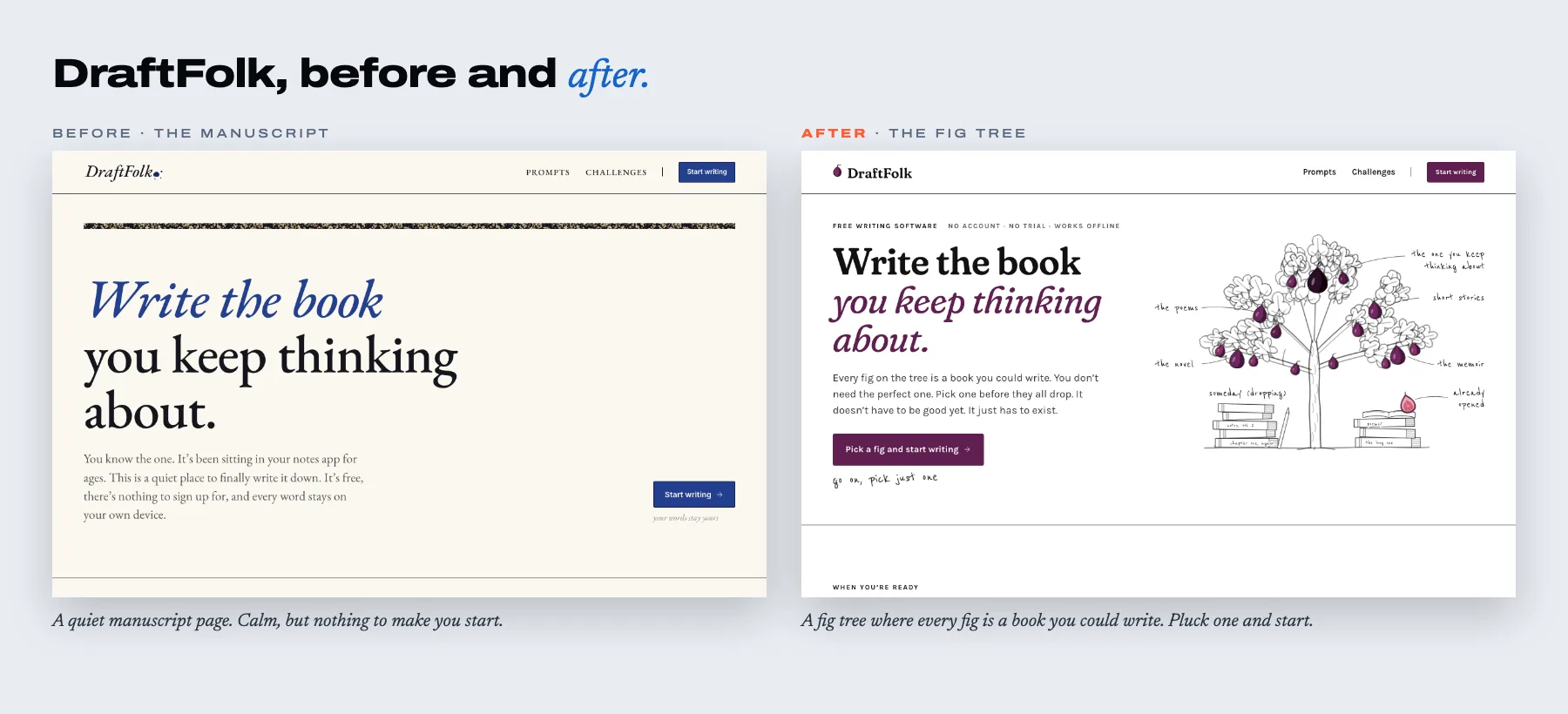
What I did. Built the Room: a distraction-free writing app with word goals and progress tracking, free, and your writing stays in your own browser. Cut every half-built community feature and every promise the site couldn’t keep yet. Relaunched it in November as a hand-drawn fig tree where every fig is a book you could write, so you pluck just one and start. Fixed the sitemap and titles, wrote guides for writers looking for somewhere new to do their November, and opened it up to AI search.
What changed. It’s a smaller site that keeps every promise it makes. You can open it and start writing straight away, and there are three 30-day programs you can start any day you like.
Skills: product focus, cutting scope, SEO, privacy by design, writing.
The Ditty. Taking a music site off someone else’s platformCase 06
The problem. The Ditty is the album review and hi-fi site I write with my co-host Ian, going since its podcast days. It lived on a newsletter platform that controlled how it looked, our subscriber list and the ads, and I wanted all of that back.
What I did. Moved it off and built it from scratch on Cloudflare: sections, search, RSS, sitemap, every image rehosted. Built our own admin with an editor, media library, ideas board, cookie-free traffic counts and a record diary. Gave it a connector so I can work on it with Claude, with nothing published until I’ve read it. Set up ads properly: a consent banner with a real “no”, and sensitive categories blocked.
What changed. 20+ posts live, all on a site we own. Google approved it for ads the day after the new site went up.
Skills: building a CMS, Cloudflare Workers, D1 and R2, migration, ads and consent, editing.
Control room. One page that tells me what needs meCase 07

The problem. Eight products, twelve sites and services, eleven scheduled jobs and five social accounts, each with its own dashboard. Nothing told me in one place what actually needed me today.
What I built. One private page behind a passkey: what needs me, what’s going out, who’s visiting and whether it’s all up. The rule is that scripts watch and agents only wake when something breaks or I ask, so it runs for £0.
What changed. On its first run it found my databases hadn’t been backing up, and a retired product failing on the backup list every week. It was all written down already, just nowhere I’d look.
Skills: product thinking, agent operations, human in the loop design, cost discipline, passkey sign-in, data honesty.
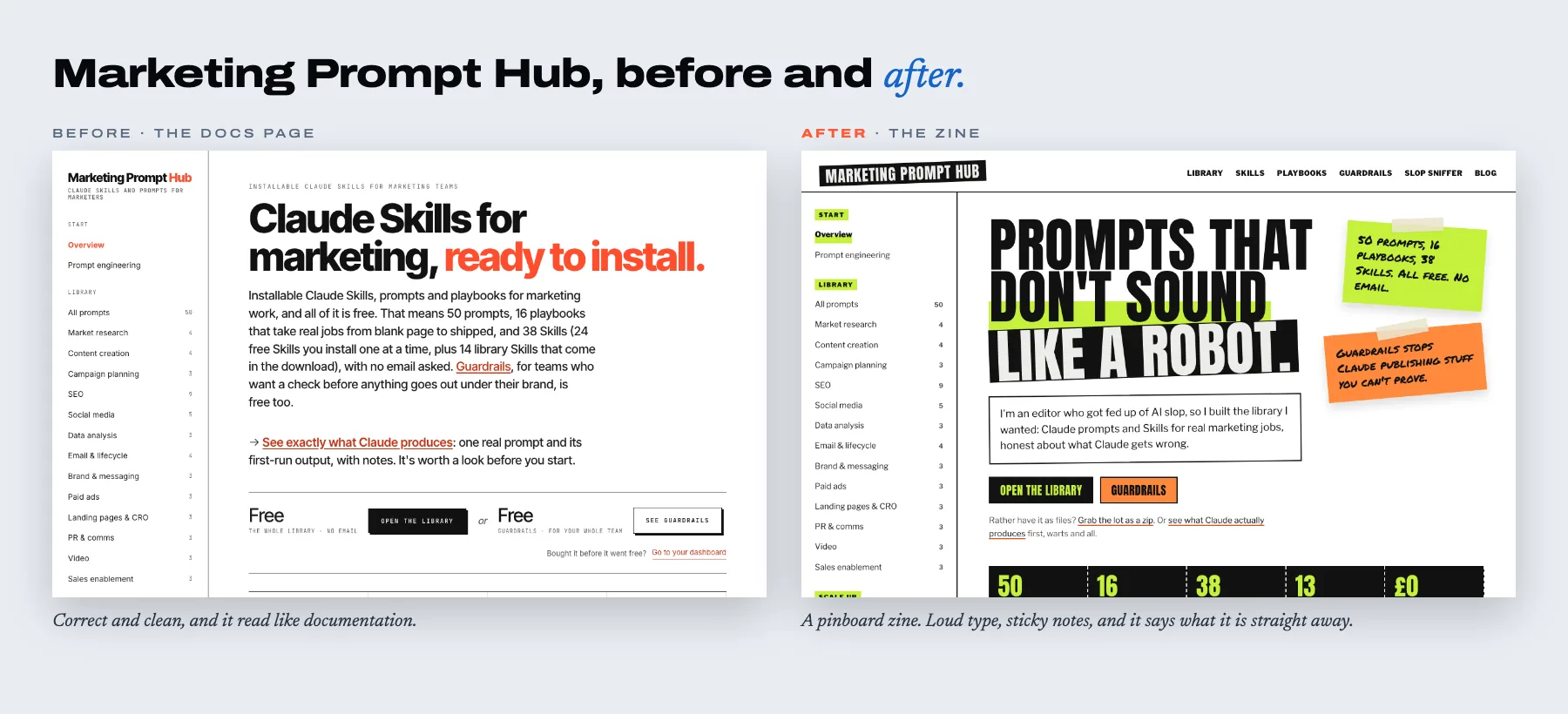
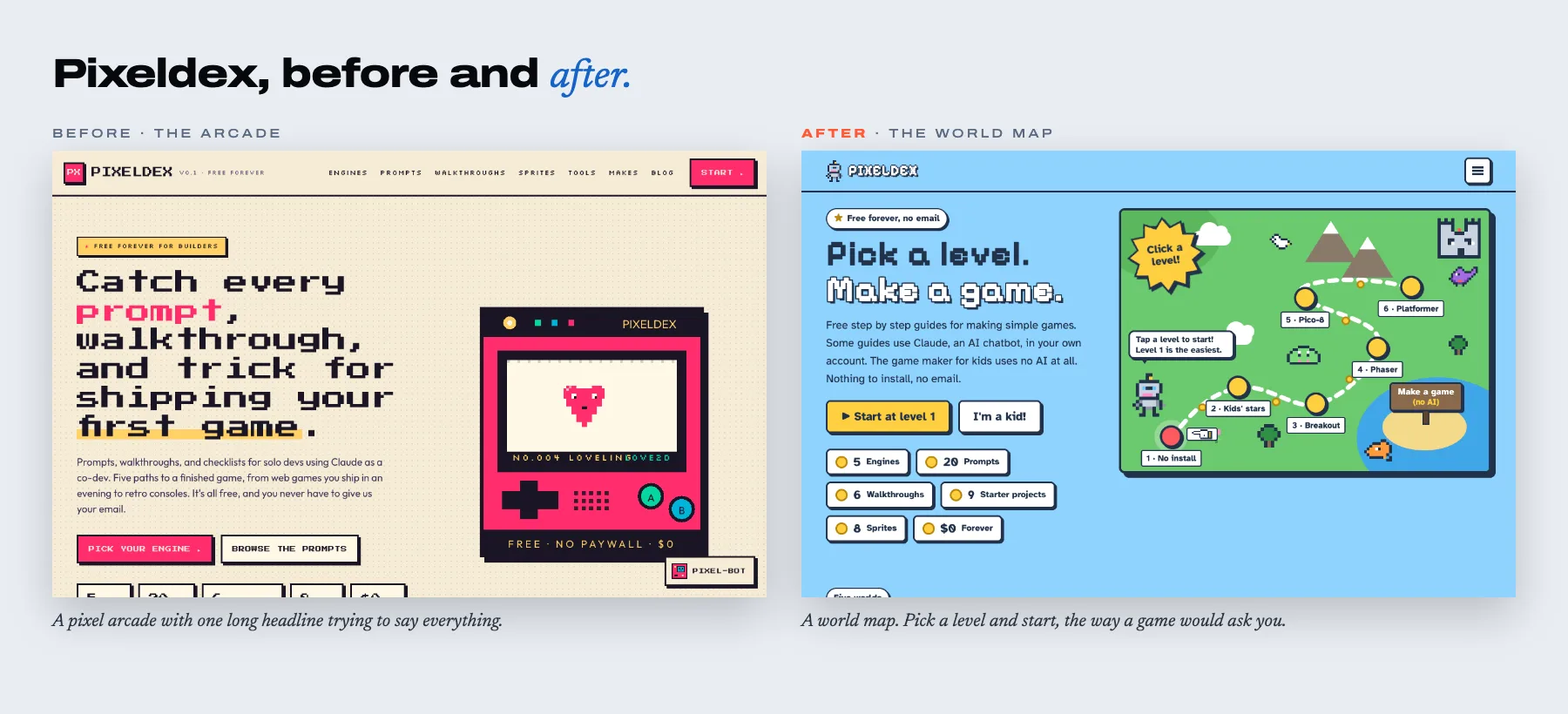
Before and after
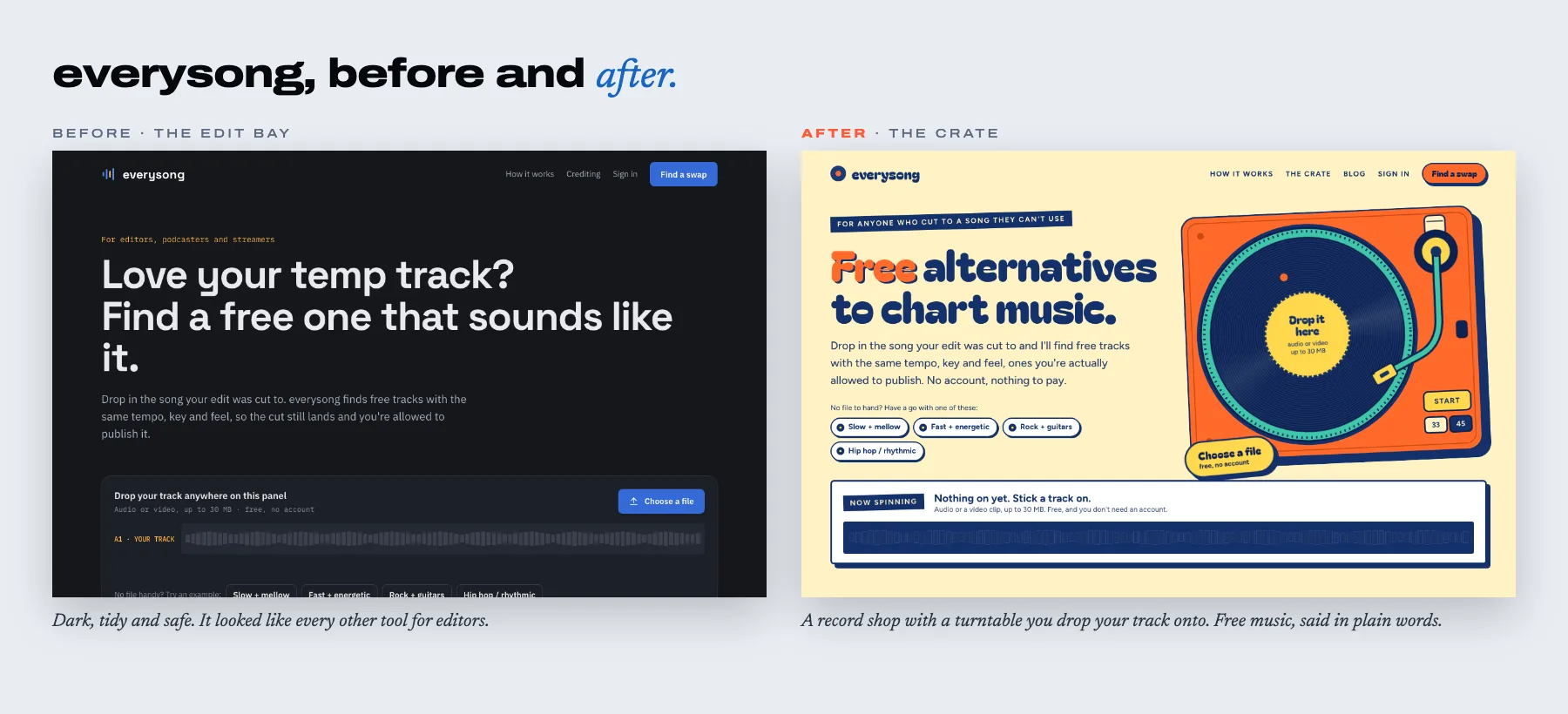
I rebuilt four more of my sites this month. Here’s each one before and after, and what I was fixing. Vera’s is in her case study above.
Skills
Each one links to the projects where I’ve used it.
AI agents, MCPs and APIs5 tracks
The Vera API and an MCP server on top of it, an MCP connector for The Ditty’s publishing platform, 38 Claude Skills, agent blueprints and a content engine that publishes on its own.
Hear it on: Vera · everysong · Marketing Prompt Hub · The Ditty · Hi-Fi Kitchen
Audio and machine learning2 tracks
Full-stack and APIs5 tracks
FastAPI on Fly.io, Cloudflare Workers, the Vera API, offline web apps.
Hear it on: Vera · everysong · Marketing Prompt Hub · The Ditty · Hi-Fi Kitchen
SEO and AI search3 tracks
Structured data on nearly every page, llms.txt, 60+ articles on one site, a decade of SEO-first content.
Hear it on: Marketing Prompt Hub · The Ditty · Hi-Fi Kitchen
Pricing and payments1 track
Stripe checkout and webhooks, refund and EU digital-goods policies, and affiliate links with plain disclosure on every post.
Hear it on: Hi-Fi Kitchen
Automation5 tracks
Scheduled publishing, a LinkedIn auto-poster, self-redeploying hosting, page generators.
Hear it on: Vera · everysong · Marketing Prompt Hub · The Ditty · Hi-Fi Kitchen
Writing and editorial4 tracks
Seventeen years of words, a weekly newsletter written by hand, house styles and voice guides.
Hear it on: Vera · Marketing Prompt Hub · The Ditty · Hi-Fi Kitchen
Experience
The highlights. Full history on LinkedIn.
B1Music24Remote2023-now
Marketing at a company with 8 brands. I’m hands-on for 5 of them: music apps with millions of users, a B2B analytics platform, an enterprise API and a group scheduling app. 33 social accounts, 4 blogs (one in 9 languages), and a weekly newsletter I still write by hand.
I use AI agents for the repetitive work and make the decisions myself. I look after content strategy, SEO and AI-search visibility, and decide what’s actually worth publishing. I’m also lead writer on the weekly music newsletter.
Highlights
5 of 8 brands · 33 social accounts · 4 blogs · AI agents
B2Freelance content and copywriterRemote2009-now
Content, copywriting, newsletters, whitepapers, ghostwriting and full rebrands for clients across tech, fintech, iGaming, SaaS, crypto, healthcare and eCommerce, including Dove, E45, iwoca and Iceland (the supermarket, not the country). HuffPost bylines along the way.
Agency work with FATJOE, Stickyeyes and Profit Engine, focused on SEO-first content for iGaming, fintech and SaaS. I write for people first. I’ve also done SEO for over ten years, and these days I make sure the work shows up in AI answers as well.
Highlights
Brand voice · Rebrands · SEO · Ghostwriting
B3Editorial board, Tenants UpdateWolverhampton Homes2014-2018
Part of the editorial team taking a 27,000-reader tenants’ magazine from print to digital. Local government changes, resident features and community impact stories, published quarterly.
Highlights
27k readers · Print to digital
B4Community and content, Shakti WomenWest Midlands2016-2018
Social strategy, newsletter copy and campaign comms for a business supporting women through mentoring and events. Curated and produced a poetry anthology end to end, from sourcing poets to running the launch night.
Highlights
Community · Events · Publishing
B5Earlierbefore
Arts centre board member, YMCA fundraising, and a few years volunteering on sustainability projects. Happy to talk through any of it.
Bookings and enquiries · based in the Netherlands · open to relocation
zara@zarawalker.co.uk
Happy to relocate for the right role. I read every email myself.
Elsewhere: GitHub · LinkedIn · The Ditty · the drum machine
Press kits: everysong · Marketing Prompt Hub · Pixeldex · Vera · The Ditty · DraftFolk · Swallowtail · Hothouse
℗ & © 2026 Zara Walker. Pressed in the Netherlands. Play loud.